Walls Don't Lie: My Index Card and Red String Method for Outlining Stories That Actually Work
Walls Don't Lie: My Index Card and Red String Method for Outlining Stories That Actually Work
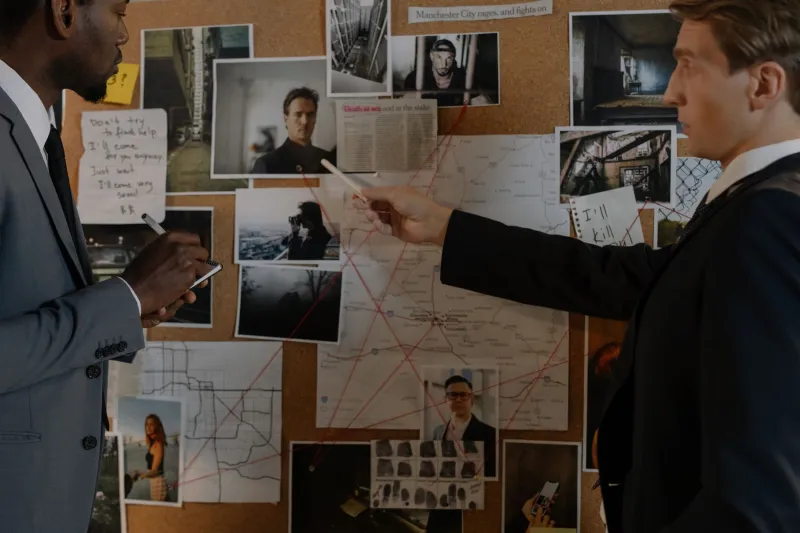
There's a moment in almost every crime thriller — you've seen it a hundred times — where the detective steps back from a corkboard covered in photos, newspaper clippings, and lengths of red string, and suddenly everything clicks. The connections are right there, stretched across the wall in front of them.
I used to watch those scenes and think, that's a little dramatic, isn't it?
Then I started doing it myself. And I haven't outlined any other way since.
Why Physical Beats Digital (At Least for Me)
I've used every outlining tool you can name. Scrivener, Notion, index card apps, beat sheet templates, spreadsheets that made me feel like I was doing taxes instead of writing a story. They're all fine. Some of them are genuinely great. But they share one problem I couldn't shake: everything lives inside a rectangle, stacked in a list, scrolled through one item at a time.
Stories aren't lists. They're webs. A character decision in chapter three should be visibly pulling tension with a plot revelation in chapter eleven. A clue planted early needs to feel like it's sitting in the same room as the moment it pays off. When everything is buried in a sidebar or collapsed in a folder tree, those relationships become invisible — and invisible relationships are the ones you forget to actually write.
The wall doesn't let you forget. Everything is out in the open, staring at you, demanding to be connected or cut.
The Setup: What You Actually Need
This isn't expensive. Here's what I use:
- A large corkboard (I have a 4x3 foot one from a craft store, but a section of wall with painter's tape works fine)
- Index cards in four colors — I'll explain the color system in a second
- Red string or yarn — yes, actual red string, because the drama is part of the point
- Push pins
- A thick black marker
- A few smaller sticky notes for late additions
That's it. Total cost is maybe fifteen dollars if you're starting from scratch.
The Color System: Four Categories, One Board
This is where the method gets structured. Each color of index card represents a different layer of the story, and keeping them visually separate is what makes the board readable at a glance.
Yellow cards — Plot Events. These are the things that happen. Scene by scene, beat by beat, the external stuff. A confrontation. A discovery. A door that opens or closes. I write one event per card, as short as possible — usually just a sentence.
Blue cards — Character Beats. These track internal shifts. A character realizes something. A relationship changes. Someone makes a choice that will cost them later. These don't always line up with plot events, and that gap is often where the most interesting story lives.
Green cards — Information and Clues. Everything the reader learns, and when they learn it. This is especially useful if you're writing anything with mystery elements, but honestly every story is managing information. What does the audience know? What are they still missing? Green cards keep that visible.
Red cards — Unresolved Questions. These are the open loops. Things I haven't figured out yet. Threads I know I need to pay off but haven't found the right moment for. The red cards are the uncomfortable ones — they stay on the board until I have an answer, or until I admit the question shouldn't be there at all.
The String: Making Relationships Physical
Once the cards are up, the string goes on. I use it to connect cards that are in conversation with each other — a clue planted in act one tied to the revelation in act three, a character beat that mirrors (or contradicts) something that happens two scenes later.
The string is not decorative. It does real work. When I look at a section of the board and there's no string touching a card, that's a signal: this beat is isolated. It's not talking to anything else in the story. That's either a problem to fix or a card to remove.
Conversely, when a card has six strings attached to it, I know that moment is load-bearing. I'd better not cut it without understanding what falls apart if I do.
How I Actually Work the Board
I don't build the whole thing in one sitting. That's a recipe for a board that looks complete but isn't honest.
I start with what I know — usually a handful of yellow plot cards and maybe one or two blue character beats. I pin them loosely, leave huge gaps, and sit with it for a day. Then I come back and start asking questions out loud. Why does this happen? What does this character want in this moment? What would make this worse? The answers become new cards.
The green information cards go up next, because once I know my plot events, I can ask: when does the reader find out about this? Is it too early? Too late? Is there a version where withholding this creates more tension?
Red cards go up whenever I hit a wall. If I can't figure out how two plot points connect, I write the question on a red card and pin it between them. The board holds the problem for me so I don't have to keep it in my head.
The Moment It Pays Off
There's a specific thing that happens with this method that I've never experienced with digital tools. At some point — usually after a few days of adding and rearranging — I step back from the board and the story just reads. Not in a linear way, but as a whole shape. I can see where it's heavy, where it's thin, where a character disappears for too long, where the act two sag is trying to hide.
That spatial awareness is hard to manufacture on a screen. The board gives it to you for free.
You Don't Have to Be a Thriller Writer
I want to be clear: this method isn't only for mysteries or suspense stories, even though it borrows the visual language of those genres. I've used it for a personal essay series, for a screenplay with no crime in it whatsoever, and for a long-form creative project that defied easy categorization.
The core principle works for anything: make your story's structure visible in physical space, and the logic you're missing will show itself.
Your wall won't judge your messy first pass. It'll just hold the cards until you're ready to connect them.
And sometimes, that's all the creative process really needs.